Full Faith and Credit Clause does not apply to Missouri
Generally every state recognizes the judgements of every other state. The United States Constitution requires this. Thus if a Missouri Court makes a judgement, a court in California is bound to recognize that judgement. However, this only applies to valid Missouri judgements. If the original Missouri judgement is a void judgement, other states don't have to recognize it, and in fact, are prohibited from recognizing it. A void judgement is a judgement that fails to meet the requirements of a judgement based on either Missouri state law or federal law. If a Missouri judgement fails to meet Missouri's own requirements for a valid judgement then that judgement can not be enforced or transferred to any other state.
 This web page is a legal reference for lawyers or anyone else who wishes to attach the validity of Missouri court decisions in any other jurisdiction. What I am about to tell you here is rather incredible and shocking
and you might find it hard to believe unless you actually see it for yourself. Missouri requires that judgements be signed by a judge, and many Missouri judgements are signed only by clerks, some are not signed at all.
And the Missouri courts that are the worst for not signing judgements are the Southern District Court of Appeals, and the Missouri Supreme Court itself. For years these courts have produced judgements that are signed
only by clerks of the court who are not authorized to sign judgements. The Missouri Rules of Court and Missouri case law is very clear that judgements are only valid if signed by Article V Judges. (Article V of the
Missouri Constitution) Any judgement lacking a judges signature is void.
This web page is a legal reference for lawyers or anyone else who wishes to attach the validity of Missouri court decisions in any other jurisdiction. What I am about to tell you here is rather incredible and shocking
and you might find it hard to believe unless you actually see it for yourself. Missouri requires that judgements be signed by a judge, and many Missouri judgements are signed only by clerks, some are not signed at all.
And the Missouri courts that are the worst for not signing judgements are the Southern District Court of Appeals, and the Missouri Supreme Court itself. For years these courts have produced judgements that are signed
only by clerks of the court who are not authorized to sign judgements. The Missouri Rules of Court and Missouri case law is very clear that judgements are only valid if signed by Article V Judges. (Article V of the
Missouri Constitution) Any judgement lacking a judges signature is void.
My point here is that if you live in California and you have a Missouri judgement against you, and that judgement was never signed, you should be able to undermine the full faith and credit clause of the Constitution by claiming that the Missouri judgement is void based on Missouri's own rules and case law. In this article I will give you the procedure for attacking the validity of Missouri judgements including the arguments and the case law that supports these arguments. Everything you need to write your brief is right here and you are welcome and encouraged to use it. What the Missouri Courts are doing is nothing less than insanity and should not spread to other jurisdictions. In fact, it is my hope that once other states stop recognizing Missouri judgements then maybe the Missouri legislature will begin Impeachment Proceedings against the entire Missouri Supreme Court and replace them with justices who are at least smart enough to write a judgement that meets Missouri's own standards for issuing a valid judgement.
What Judgements are Invalid?
Missouri courts are organized into three levels. At the bottom are the circuit courts. Then there are three courts of appeal which include the Southern District located in Springfield; the Western District located in Kansas City, and the Eastern District located in St. Louis. At the top is the Missouri Supreme Court located in Jefferson City, the Missouri state capitol.
Most all of the circuit court judges sign their judgements, but not all. Many circuit court decision are unsigned or improperly denominated judgement or decree. I know that the judgements in the Missouri Court of Appeals, Southern District are all signed by the clerk and not by judges and are all invalid. This is also true of the Missouri Supreme Court. I am told that the Western District Court of Appeals judgements are properly signed by judges and I don't know about the Eastern District.
Often appellate decisions cite other decisions made by other courts. Many circuit court judgements cite appellate and Supreme Court decisions. You may have a properly signed decision that relies on a case that wasn't properly signed. I believe that an argument could be made that a decision that relies on a void decision is also void, especially if the reliance on the void decision supports a crucial element of the decision. Thus many properly signed judgements might, in fact, be void as well.
The judgements from the Missouri Supreme Court and the Southern District Court of Appeals are not signed by judges as required by Missouri Court Rules |
It is interesting to note however, that the Slay decision itself was signed by a clerk, not by a judge.
The Slay decision caused a lot of fear and loathing because it threw hundreds of decisions into jeopardy. Later in 1998 the Missouri Supreme Court validated those decision on the basis that the law had an appeal remedy built in and that those who failed to pursue the remedy are blocked by estoppel and waiver from challenging the decision, York v. Daugherty, 969 S.W.2d 223 (Mo. 06/16/1998).
What Constitutes a Valid Judgement in Missouri?
The signature requirement of Missouri judgements are governed in part by the plain language of two rules which state:
Rule 74.01(a) Included Matters. "judgement" as used in these rules includes a decree and any order from which an appeal lies. A judgement is rendered when entered. A judgement is entered when a writing signed by the judge and denominated "judgement" is filed. The judgement may be a separate document or included on the docket sheet of the case.
Administrative Rule 4.09(6) ... Orders or judgements entered on the docket sheet(s) by the judge or the clerk shall be signed by the judge or supported by a memorandum in the file signed by the judge.
In addition to the plain language of the rules, there are a number of cases that have upheld these rules. As explained in Martin v. Director of Revenue State of Missouri, 10 S.W.3d 618 (Mo.App. E.D. 02/15/2000) citing the case of Lowery v. Air Support International, Inc., 971 S.W.2d 323, 324 (Mo.App. S.D. 1998), a judgement is entered when:
It is interesting to note however that the case of Martin v. Director of Revenue State of Missouri was decided by the Southern District Court of Appeals and even though the opinion stated the requirement that a judgement needs to be "signed by the judge", the Martin case was signed by the clerk. When Mr. Lee Martin asked for a copy of the judgement signed by a judge, they refused and told him there was no copy signed by a judge. What that means legally is anybody's guess. I would argue that the policies and procedures in Missouri Courts do not meet the minimum standards of the 14th Amendment right to due process of law.
You may be wondering if this lack of a proper signature is merely a formality and can be ignored. This issue has also been decided. The case of Leonard O. Larue V. Janette Lohman, Case # 71802 establishes a bright line test on the validity of orders and judgements. That bright line test is that the judgement or order must be IN WRITING and SIGNED BY THE JUDGE. It states:
So, you may ask, "what if the judges just went back and signed these judgements now?" Well, they can't do that either. In Keck v. Keck No. 75021 (Mo.App. ED 05/11/1999) the court was faced with the issue of trying to retroactively convert the "findings and recommendations" of Commissioner Winston G. Davis into an appealable judgement by nunc pro tunc amendment. The court failed to do so stating:
Allowing the use of Rule 74.06(a) to create a retroactive judgement undermines the express language of Rule 74.01(a) and the reasons for its creation. Rule 74.01(a) establishes a bright-line standard designed to notify all parties with certainty that the court has entered judgement. Entry of judgement is a significant legal occurrence. The date a judgement is rendered is significant because it is the date from which the timeliness vel non of post-trial and appellate filings is measured. See Rule 75.01; Rule 78.04; Rule 81.05. To allow the rendition of judgement at times other than when entered would create tremendous uncertainty throughout the post-trial and appellate process.
Thus, in Keck v. Keck the court ruled that judgements can not be signed retroactively because the act of signing it establishes the date of the judgement. Someone on death row, for example, would be entitled to a new set of appeals because the signing of the order would reset time for the appellate process. (Rule 81.05) There are some exceptions to this. There is case law that if the lack of a signature was clearly an oversight and a well documents one time occurrence, it can be fixed upon establishing the judge clearly intended to sign it. But this wouldn't apply to a court that doesn't sign any judgements and the clerk gets the judgement second had through the research lawyers.
There may be people on death row in Missouri who's appeals and death warrants were signed by a clerk! |
Thus, I think it could be argued based on this case that the term "any kind of a proceeding" would include a judgement made by a court in another state who is asked to enforce a Missouri judgement and the foreign court would have subject matter jurisdiction to consider the issue of whether or not the Missouri Judgement met the Missouri's own standards of validity.
Full Faith and Credit
The effects of the res judicata doctrine extend to judgements rendered in other States through the full faith and credit clause of the Constitution, which requires that "the judgement of a State court which had jurisdiction of the parties and the subject-matter in suit, shall be given in the courts of every other State the same credit, validity and effect which it has in the State where it was rendered, and be equally conclusive upon the merits . . . ." Roche v. McDonald, 275 U.S. 449, 451-452 (1928)
. There are, however, exceptions to the full faith and credit rule. The two that apply here are:
Thus, if you can show a California court that a Missouri judgement fails to meet the bright line test outlined on the Missouri decisions cited here, then you should be able to get the court to rule the judgement void even if it were upheld in Missouri. Just because Missouri judges don't know how to write a judgement and Missouri has sloppy constitutional customs, doesn't bind other states to the same low standards.
The 14th amendment of the United States Constitution gives everyone a right to due process of law, which includes judgements that comply with the rules and case law. Most due process exceptions deal with the issue of notification. If, for example, someone gets a judgement against you in another state without your having been notified, you can attack the judgement for lack of due process of law. In Griffen v. Griffen, 327 U.S. 220, 66 S. Ct. 556, 90 L. Ed. 635 a pro se litigant won his case in the Supreme Court who stated:
Procedural due process, does that include the lack of a judge's signature when the rules clearly require a signature? I think would so. The argument may not fly in a Missouri court, but any sane jurisdiction would have to uphold it.
Although it would be a harder argument to make, I think that if a good lawyer were to take the conduct of Missouri courts as a whole, that an argument can be made that no Missouri judgement is valid. In a state where the highest courts openly refuse to obey their own rules and abide by their own decisions, can any judgement that comes from that environment be relied upon to represent a judicial process? What does it mean when the Missouri Supreme Court in Slay v. Slay rules that only judges can sign judgements, yet that decision is signed by a clerk?
The Missouri Supreme Court is not a judicial system, it's a circus. |
How to Proceed in Attacking Missouri Judgements

|
Chief Justice Impersonator Missouri Supreme Court |
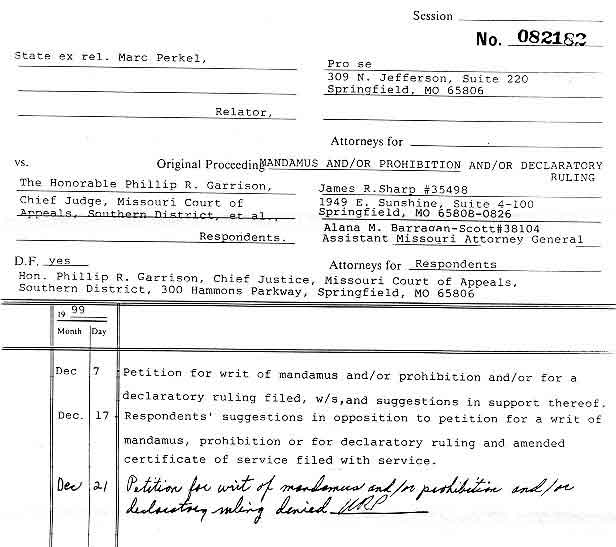
Missouri law also requires that the judgement be denominated "Judgement" or "Decree", and that if the judgement lacks this denomination, it's not a valid judgement. Here's an Example of an Invalid Missouri Judgement. In this example the judgement is hand written on the docket sheet. That's legal. It also has the judge's initials rather than the judges signature. That to is legal. However, it lacks the denomination of judgement or decree and is therefore void. What judge made this void judgement you ask? Why this judgement is the work of William Ray Price, the Chief Justice of the Missouri Supreme Court! This would be funny if it weren't so tragic. Missouri's Chief Justice can't write a judgement. How pathetic.
Demand a copy of the judgement with a judges signature. If they fail to produce it, you win! |
If a properly signed judgement relies on a decision that wasn't properly signed, it can be argued that it is void as well. |
The History of how this came to be Discovered
You're probably asking yourself how it is that I, a non-lawyer came to discover all these things about the Missouri courts? Well, it's quite a story and is best told by exploring the rest of this web site. It started with my divorce where I ended up with a judgement for more than 100% of everything I own. I was represented by counsel during my divorce trial. After that I get rid of the lawyers and learned the law on my own. Bought a few books and started researching the law on the Internet. With the web there's a new breed of highly skilled pro se litigants and the courts are having a harder time screwing us.
After the Slay v. Slay decision in 1998, I remembered a decision I got for maintenance that cost me about $40,000 that I thought was made by a commissioner. I looked up the original order and found out it wasn't signed by a commissioner. It was Not Signed by Anyone! So I filed an action in equity to have the Order Declared Void.
The Missouri Court of Appeals actually refused to provide me with an order signed by a judge. The refusal was signed by the clerk! |
Rather than repeat myself, it ended with me calling for the Impeachment of the Entire Missouri Supreme Court. Follow that link and read the whole case. It will amaze and astound you. When you see the hard evidence of how sloppy, incompetent, and corrupt the Missouri courts are, you'll see how easy it is to make an argument in every other state that Missouri judgements can not be relied on as judicial decisions and should be ignored by every other court.
Feel free to use any and all the information here in your cases to undermine the powers of Missouri judgements and the judicial impersonators who call themselves justices. Hope you have better luck than I have.
What I Hope to Accomplish
The Missouri judiciary is totally out of control. It the kind of thing that happens when constitutional safeguards are circumvented. Our forefathers set up a checks and balances system whereby each of the three branches of government ensures that the other branches play by the rules. By adopting self regulation the judiciary has opted out of the checks and balances system and has usurped the powers of the King.
The courts will argue that there is a checks and balances system. Missouri has a Commission on Retirement, Removal, and Discipline which is supposed to keep judges in line. However, this commission is controlled by the Missouri Supreme Court. I contacted them and complained stating that Missouri justices refuse to sign judgements and asked them to take disciplinary action against the Missouri Supreme Court. They responded that it was a judicial decision and they are without jurisdiction to act.
From the preamble to
|
We must never let judges forget that the courts exist for the sole purpose of serving the judicial needs of the people and for no other reason. |
These judges are above the law and they know it. That's why they can make a decision that only judges can sign judgements, and then have the clerk sign it. Missouri judges are no more than lawless judicial impersonators who have committed treason to the constitution and are no more than predators upon the people.
 I created this web page in the hopes that there is, somewhere in America, a single judge in any other state who will stand up and say that this is wrong and that Missouri judgements are invalid for lack of a proper
signature. Should such a ruling occur it can be cited in cases by other states and the powers of Missouri courts will be undermined and Missouri judges will be isolated. Such a condition would logically demand a
solution from the legislature and/or the United States Supreme Court, who would hopefully craft a solution that will actually work. A solution that will ensure that the courts understand that they exist solely for the
purpose of serving the public, and for no other reason.
I created this web page in the hopes that there is, somewhere in America, a single judge in any other state who will stand up and say that this is wrong and that Missouri judgements are invalid for lack of a proper
signature. Should such a ruling occur it can be cited in cases by other states and the powers of Missouri courts will be undermined and Missouri judges will be isolated. Such a condition would logically demand a
solution from the legislature and/or the United States Supreme Court, who would hopefully craft a solution that will actually work. A solution that will ensure that the courts understand that they exist solely for the
purpose of serving the public, and for no other reason.
In the case of Elkins Et Al. v. United States, 364 U.S. 206, 80 S. Ct. 1437, 4 L. Ed. 2d 1669 the United States Supreme Court, speaking about the imperative of judicial integrity stated:
In protest, I have burned my census form on the steps of the Missouri Supreme Court. I will continue to take further steps until they are forced to comply with the law.
|




Case Law $7/Month 50 States + Fed
I use this service.